
For anyone staring at a cut loaf
Read the crumb. Fix the next bake.
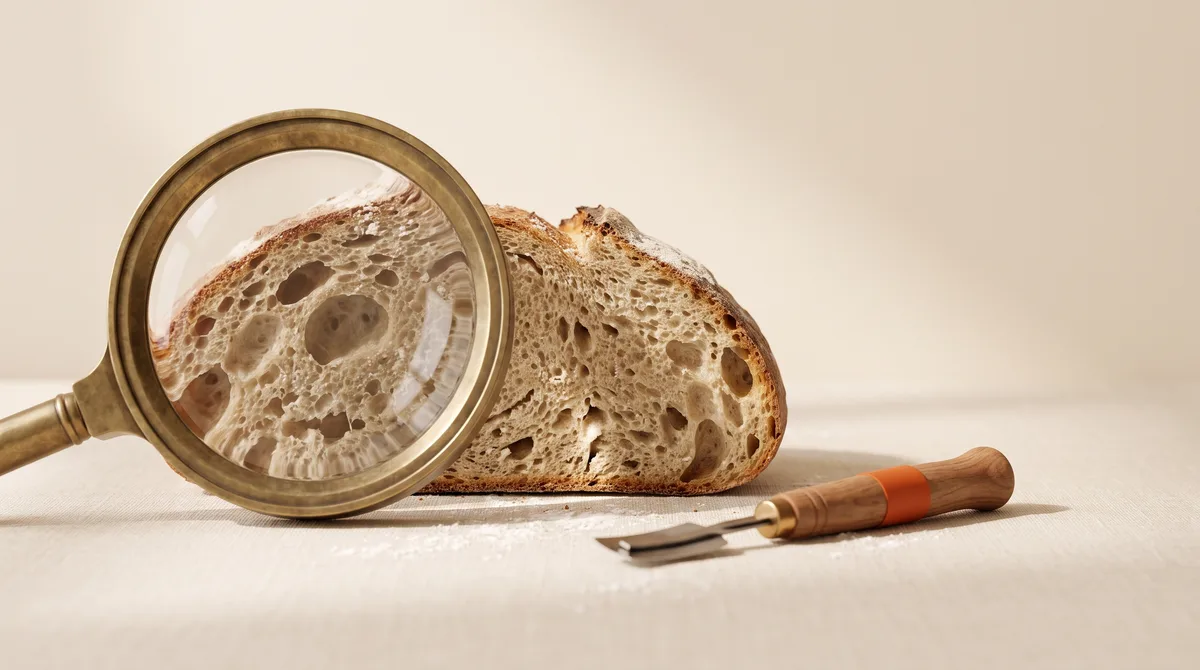
Dense bottom, big tunnels, a cavity under the crust: every loaf is telling you what happened. Loaf Scout reads it like a baker would, calls the proof honestly, and says the one thing to change next time. The starter jar too.
Free toolsNo sign-upNamed sourcesOne change at a time
Move over a slice. It stands up so you can read its crumb.
- Uneven crumblikely
- Strong earlikely
- Deep crustseen
Well proofed, baked through, even from top to bottom. The read says what to repeat, so the next loaf is not luck.
A small nudge: a little under or over, a pale crust, a missing ear. One timing or oven tweak, nothing structural.
One clear fault with one lever that fixes it: bulk, proof, shaping, bake, hydration or cooling. Change that and only that.
More than one thing to change, in order. The read puts the biggest lever first so you are not guessing.
Free tools
Four free tools for the kitchen-counter question
The same proof scale, findings and maths the Loaf Scout app uses, written out so you can work it through by eye tonight. Every result links the guide that explains it.
 Start here
Crumb troubleshooter
Seven questions about the cut loaf: the base, the holes, the crust, the ear, when you cut it. Ends in a proof call, the likely faults and the one lever to change first.
Read the crumb Starter
Starter feeding calculator
Pick a ratio and how much to keep, get the grams, the likely peak window on the clock, and when the starter is ready to mix.
Plan the feed Dough
DoughHydration calculator
Grams to true hydration with the starter counted, the water for a target, and a whole recipe scaled to the dough weight you want.
Do the maths Schedule
Bake planner
Bread at six tomorrow? The planner works backwards through bake, proof, shape, bulk and mix to the hour you need to feed the starter.
Plan a bakeHow the app works
One photo. One honest read. One change.
- 1
Cut it, cool it, photograph it
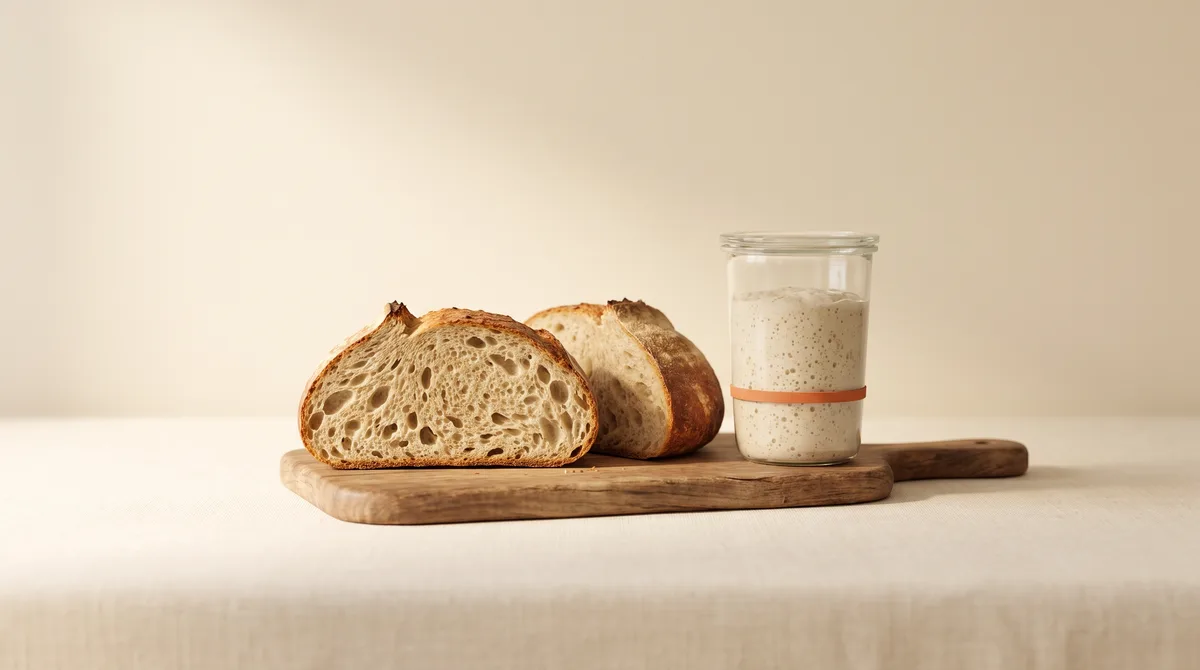
The cut face of a loaf, straight on, in daylight. Or the starter jar from the side with the band in the frame. From the camera or your library.
- 2
Say what you know
When you cut it, the flour, the hydration if you know it. For a starter: hours since the feed, the ratio, how warm the room is, what it smells like. All optional.
- 3
Get the read
A proof call with an honest range, a Loaf Score, openness and evenness, what the holes and the base say, what went right, and one of four verdicts.
- 4
Change one thing, bake again
Two or three next-bake changes, biggest lever first, each with a concrete range. Every read stays in your log, so the score can climb bake by bake.
What the read looks at
What a cut loaf gives away
The read looks at the same five things an experienced baker does. Each one points at a lever, and the levers are few: bulk, proof, shaping, bake, hydration, cooling.
The base a dense band means under
A tight, sometimes gummy band along the bottom is the classic sign of underfermentation, or a pot that was not hot enough.
The holes size and spread
Big irregular tunnels next to tight crumb point to under. An even, open web of mixed sizes from top to bottom is the goal.
Under the crust the fool's crumb
One cavity right under the top crust, with dense crumb below it, is a dough that could not expand evenly.
The profile and the ear tall or flat
A flat, spread loaf with a weak ear usually went too far. A tall round loaf with a dramatic blowout usually did not go far enough.
When you cut it the honest caveat
A loaf cut warm reads gummy whatever the bake did. The read asks, and it says so before it blames the oven.
From the guides
Plain answers for the loaf on the counter
Every guide reads a sign the way a baker would, says what it usually means, and ends with the one thing to change next bake.
The honest bit
Loaf Scout is not a baker who was in your kitchen. It gives an AI read of one photo; your own eyes, nose and the poke test still count. A photo cannot feel how the dough jiggled, taste the sourness, or see that your oven runs hot, and a tight crumb in a whole wheat loaf is not a fault. Every page names its sources, we never invent ratings or user counts, we never name a flour or oven brand in a guide, and every guide ends the same way: change one thing, then bake again. The one rule that never bends is starter safety: fuzzy mold or pink streaks means the jar goes, whatever any read says.
Questions
Good questions, straight answers
Is my sourdough underproofed or overproofed?
Look at the whole loaf, not one hole. A dense band at the bottom, large tunnels beside tight crumb, a cavity under the top crust or a dramatic blowout point to underproofed. A flat spread profile, a pale crust, a collapsed honeycomb and a weak ear point to overproofed. The crumb troubleshooter walks through the seven signs and calls it.
Why is my sourdough dense and gummy?
Three usual reasons, in order: it was cut too soon (a loaf needs 1 to 2 hours to set, longer for a big one), it was underbaked, or the dough was underfermented. If you cut it warm, bake the same recipe again and wait before you judge it. If it was fully cool, the troubleshooter separates the other two.
How do I know when my starter is ready to bake with?
At or near its peak: risen about double past the band, a domed top just starting to flatten, bubbles of mixed sizes right to the top, and a sweet sour smell. With a 1:1:1 feed in an average room that is about 4 to 6 hours after feeding; a 1:5:5 feed takes 8 to 12. The feeding calculator puts the window on the clock.
What does hydration mean, and what should mine be?
Water as a percentage of flour by weight, with the starter counted as half flour and half water. 65 to 75 percent is the classic range: open enough, still shapeable. Whole wheat and rye drink more; beginners do better starting lower. The hydration calculator works it out from your grams.
Is a Loaf Scout read a guarantee?
No. Loaf Scout gives an AI read of one photo; your own eyes, nose and the poke test still count. It cannot feel the dough, taste the loaf or see your oven. It is a consistent pair of eyes that remembers what last month's loaf looked like, and it points at one lever instead of five.
Is Loaf Scout free?
The four tools and every guide on this site are free with no account. The app is free for 3 photo reads, and the bake log, the starter page, the tools and the guide stay free for good. Loaf Scout Pro adds unlimited reads, the Loaf Score trend across bakes and side by side comparison of any two bakes.
What happens to my photos in the app?
The photo is sent to Google Gemini, an AI service, only to be read, and it is not stored on our servers. Your bakes, your starter log and your results stay on your phone. There is no account and no login, and you can delete everything from the app at any time.